

Automated Extraction for Sensitive Analysis of Alcohol Metabolites in Common Forensic Matrices
Various extraction methods for alcohol metabolites in urine have been published, including the use of anion exchange in traditional solid phase extraction. This application demonstrates an automated, fast, and highly sensitive extraction method for alcohol metabolites, ethyl sulfate (EtS) and ethyl glucuronide (EtG), in urine and oral fluid. The method uses only 50 μL of matrix for minimal sample volume, a four-fold total dilution factor, and extracts 96 samples in 10 minutes.
Materials and Methods
The method was performed on a MICROLAB® NIMBUS96 automated liquid handler (ALH) from Hamilton Robotics with XTR tips containing strong anion exchange (SAX) sorbent from DPX Technologies (Columbia, SC). The sample is composed of 50 μL of matrix fortified at various concentrations, 10 μL of internal standard (Cerilliant, Round Rock, TX), and 450 μL of acetonitrile. Well plates for conditioning, wash, and elution steps were pre-aliquoted for the extraction. Internal standards used were ethyl-D5 sulfate sodium and ethyl-D5-ß-D-glucuronide. Quantisal was used for oral fluid calibrators and QC’s, while donor human urine was used for urine calibrators. Quality control samples were obtained from various sources. Oral fluid quality control samples were made in-house by a separate scientist. The high-level urine quality control was obtained from UTAK (Valencia, CA) while the two other quality control standards were diluted from the high level with blank human urine to two additional quality control levels. The protocol followed bind, wash, and elute steps as described in Table 1.
Table 1.
| 1. Condition | Condition XTR tips by aspirating and dispensing 750 μL of 50/50 methanol/acetonitrile to prepare resin for binding. |
|---|---|
| 2. Bind | XTR tips aspirate and dispense 500 μL sample solution 5x to maximize binding. |
| 3. Wash | Aspirate and dispense wash solution, 750 μL of 50/50 methanol/acetonitrile 2x, to remove matrix interferents. |
| 4. Elute | Elute analytes of interest by aspirating and dispensing 500 μL of 2% hydrochloric acid in acetonitrile 5x. |
Analysis was performed on a Shimadzu LC40 paired with a SCIEX 6500+ mass spectrometer. The analytical LC column was a Restek Ultra Biphenyl, 3 μm, 100 x 2.1 mm HPLC Column (PN 9109312). The choice of this biphenyl column allows for optimal separation of EtS and EtG. Injection volume in this case was 5 μL, and mobile phases were 0.1% formic acid in water and 100% acetonitrile. This method was evaluated for linear dynamic range, extraction recovery, matrix effects, and limits of detection and quantification. Linearity was assessed by analyzing oral fluid and urine at seven concentration points ranging from 25-1500 ng/mL of both EtS and EtG, covering common cutoffs associated with both matrices.
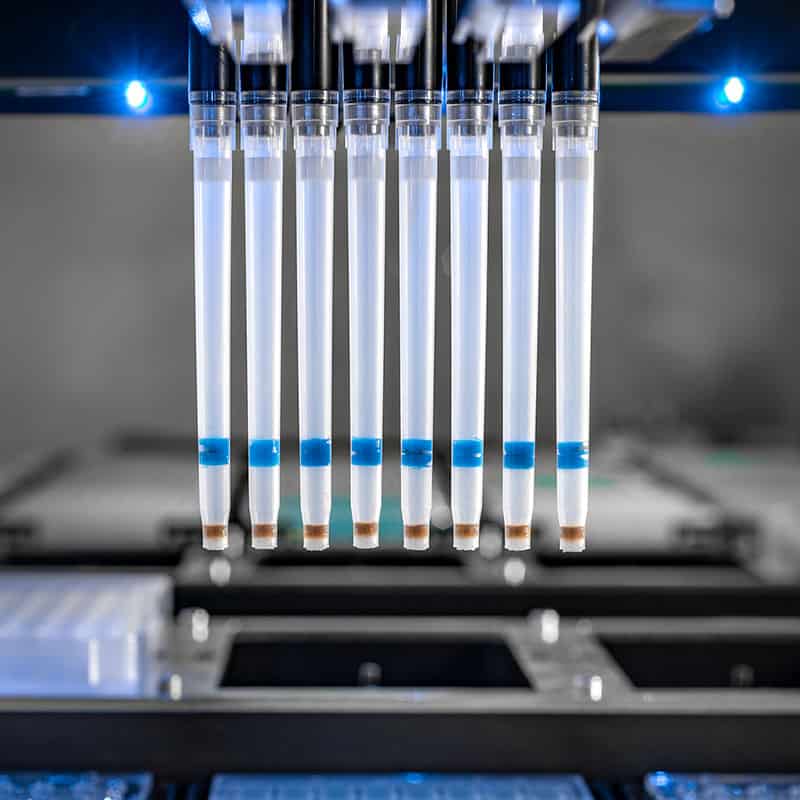
XTR Tips
Unlike traditional SPE, XTR tips utilize a patented Dispersive Pipette XTRaction technology. Sorbent chemistry is loosely contained within pipette tips; during aspirate and dispense cycles, the disperser actively mixes sample and sorbent, increasing interaction efficiency. XTR tips can hold 1 – 100 mg of sorbent depending on the tip size.