

INTip Size Exclusion Chromatography for Proteomics Sample Preparation
Learn about how INTip Size Exclusion Chromatography works and best-fit applications.
Introduction to Gel Filtration Size Exclusion Chromatography (SEC)
Gel filtration chromatography is a traditional method used to separate molecules based on size. Desalting and buffer exchange are group separation methods where small molecules, such as salts, are separated from a group of larger molecules, such as proteins. A buffer or water is used to equilibrate a gel-filtration matrix through which protein samples pass. The passage of a protein sample through the column of porous resin facilitates buffer exchange and desalting. The small molecules take the longer, slower path through the pores of the resin, while the larger protein does not. As a result, the protein separates from the small molecules/undesired buffer and passes through the column.
Gel-filtration Chromatography with SEC Tips from DPX
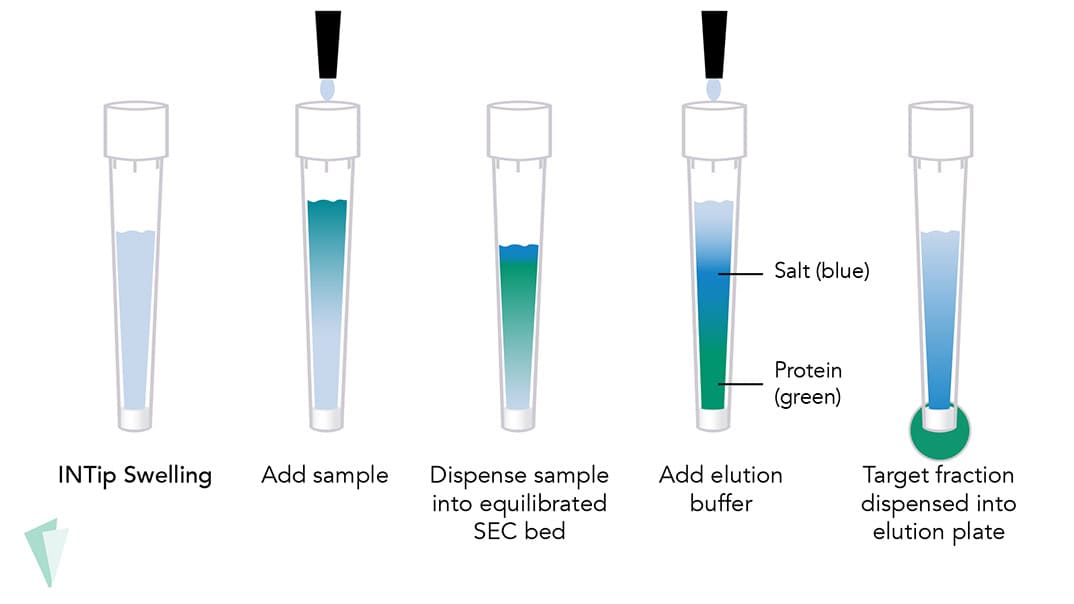
SEC tips from DPX Technologies are filled with loose resin media; varying molecular weight cutoffs are available. Unlike traditional, manual column packing, SEC tips from DPX technologies facilitate a patent-pending, automated INTip Swelling.
For automated INTip swelling, SEC tips aspirate swelling buffer or water, depending on the application to create a perfectly equilibrated resin bed.

Samples are passed through the equilibrated column. The protein target fraction is eluted through a dispense step. Positive pressure is used for each step of the workflow facilitating a fast and robust automated method.
This video demonstrates large and small molecule separation inside our pipette tip column
Technology Comparison for Desalting and Buffer Exchange
Common products for gel-filtration size exclusion chromatography include gravity flow columns, centrifuge (spin) columns or chromatography cartridges.
| Core Technology | How it Works |
|---|---|
| Dispersive Micro-chromatography | Loose resin in a pipette tip. Mixing through aspirate and dispense steps. |
| Cartridge-based micro-LC | Column bed pre-packed and bed height is fixed. Controlled flow, LC style, liquid forced into device |
| Manual Spin Columns | Pre-packed, disposable gel filtration. Resin is pre-hydrated and uniformly packed. Bed height and compressions are fixed. Force generated by centrifuge pushes sample through resin bed. |
| DPX Size Exclusion Chromatography tips | Pipette tips contain loose resin mass. The mass of resin varies based on the desired column volume. INTip swelling hydrates resin to create a perfectly equilibrated gel-filtration column inside the pipette tip. Gravity flow or automated positive pressure to force liquid through the pipette tip column. No centrifugation steps are required to prepare the tips. |
4 Reasons Size Exclusion in a Pipette Tip Wins for Modern Drug Discovery
Modern biologics pipelines demand speed, parallelism, and automation. Pipette-tip size exclusion chromatography delivers all three- turning a slow, serial bottleneck into a fast, scalable workflow advantage.
1. Discovery Speed
- Complete desalting and buffer exchange in under 30 minutes
- Replace hour-long manual workflows
- No manual preparation steps for the gel-filtration column i.e. no manual slurry prep and no centrifugation steps
- Keep experiments moving without scheduling chromatography systems
2. True Parallel Processing
- Process 1- 96 samples simultaneously
- Make decisions across whole data sets, not one sample at a time
3. Automation Native Design
- Work seamlessly with common liquid handlers– DPX SEC tips available on Hamilton robotics platforms
- Minimal hands-on time – free scientist to focus on data, not sample preparation
- Standardized workflows, reduce variability and rework
4. Gentle, Reproducible Size Exclusion
- High salt removal with strong recovery and low variability
- More reproducible than manual spin methods
INTip Size Exclusion Chromatography brings the proven principles of gel filtration into a format designed for high-throughput, fully automated methods. SEC tips eliminate traditional bottlenecks of manual methods while increasing reproducibility.